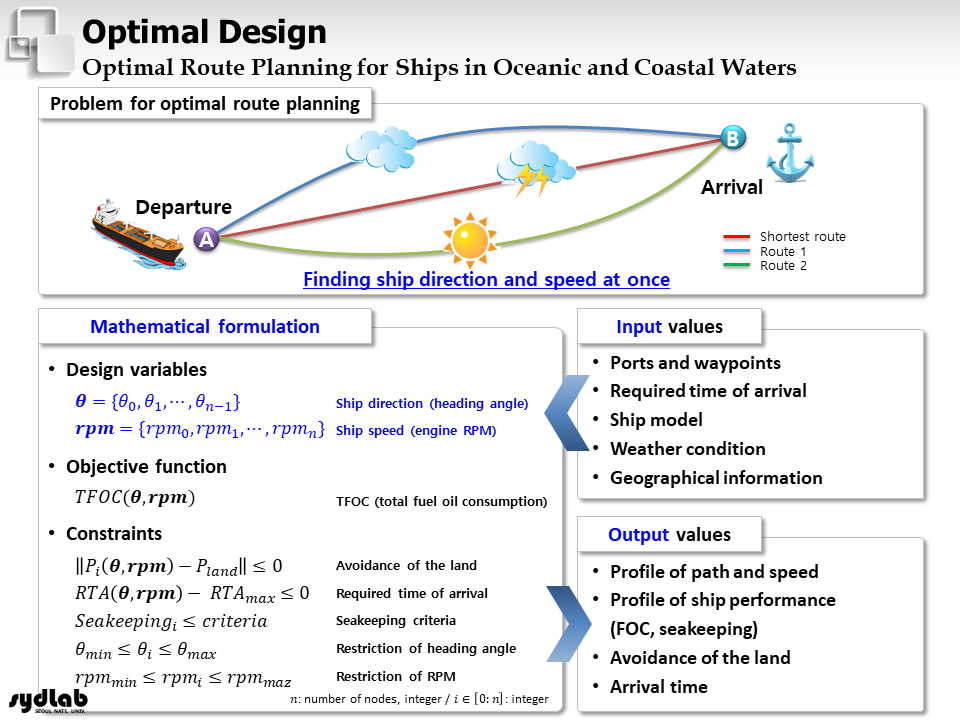
We are studying a method for optimal route planning for ships operating in oceanic and coastal waters. The proposed method has been integrated into commercial solutions, including those used by major shipyards, and has demonstrated its performance.
– Acquisition, preprocessing, and storage of weather data – Prediction of ship performance (added resistance, speed reduction) and fuel consumption based on weather conditions – Utilization of coastline, maritime objects, and bathymetric information via electronic nautical charts – Utilization of historical AIS (Automatic Identification System) data – Route finding algorithms capable of rapid computation – Formulation of the optimal route planning problem (simultaneously considering direction and speed) and optimization algorithms
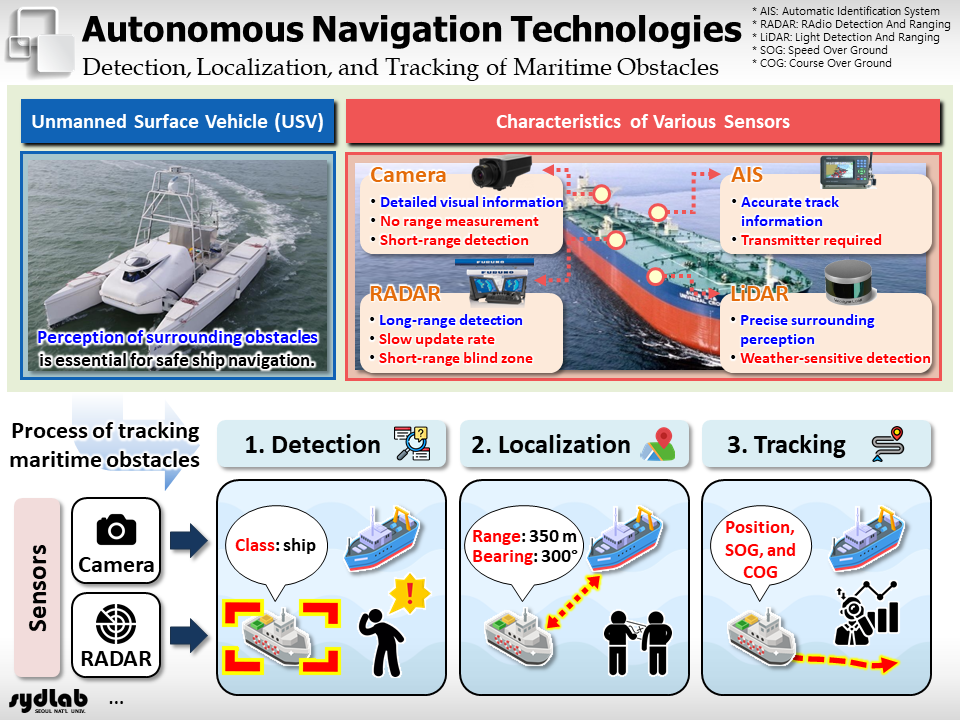
Detection, Localization, and Tracking
We are studying various methods for recognizing maritime situational awareness around ships using various sensors. This includes methods for detecting, localizing, and tracking maritime obstacles using cameras, RADAR, LIDAR, and AIS (Automatic Identification System).
– Detection of maritime obstacles – Localization of maritime obstacles – Tracking of maritime obstacles
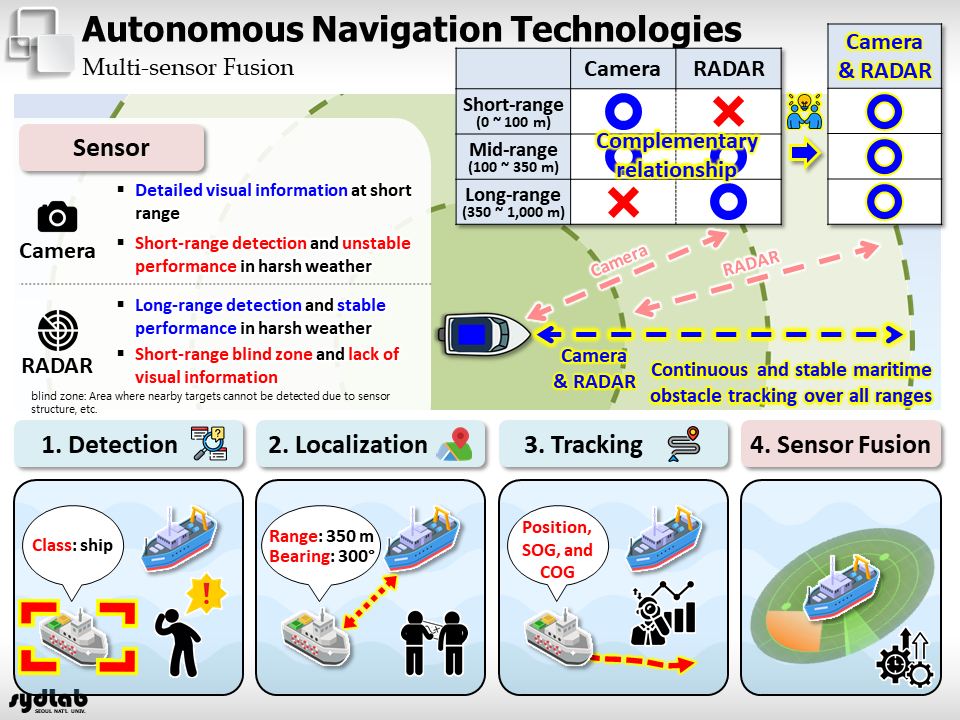
Multi-sensor Fusion
We are studying multi-modal sensor fusion methods using multiple sensors (cameras, RADAR, LiDAR, AIS, etc.) for maritime situational awareness.
– Generation of virtual sensor data for training deep learning models – Multi-sensor and multi-modal sensor fusion algorithms
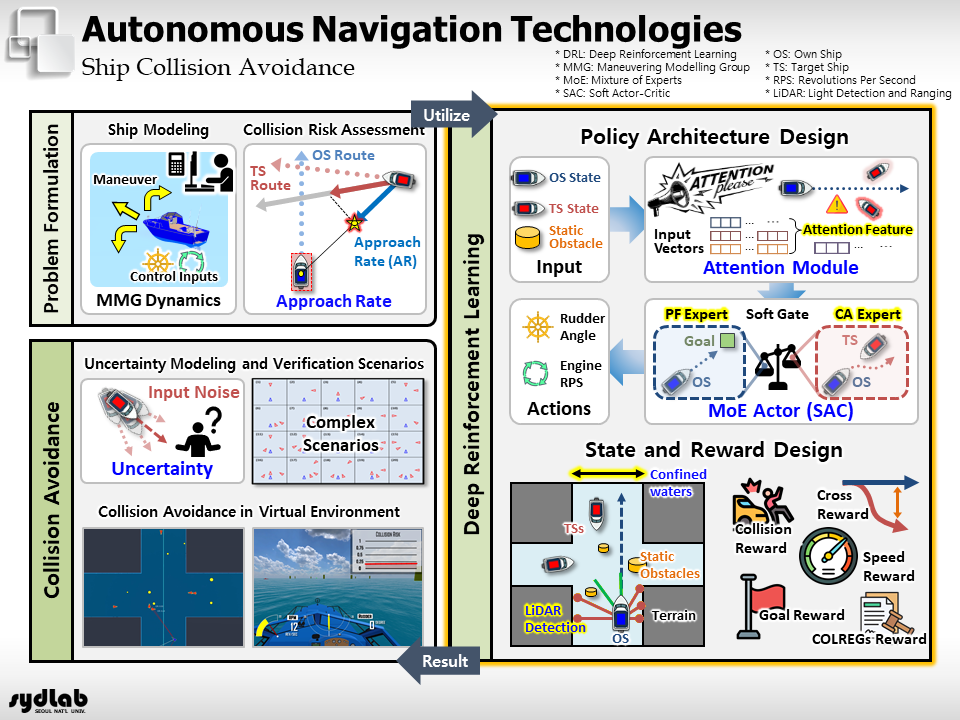
Ship Collision Avoidance
We are studying collision avoidance methods to prevent collisions with static and dynamic obstacles at sea during ship operations. We are studying how to calculate collision risks based on maritime conditions and to generate collision-avoidance paths using both rule-based and deep-learning (reinforcement learning) approaches.
– Accounting for uncertainty in sensor data – Calculating collision risk – Generating collision avoidance paths – Automatically generating encounter scenarios for reinforcement learning – Accounting for dynamic/static obstacles and narrow waterways
Ship Automatic Berthing
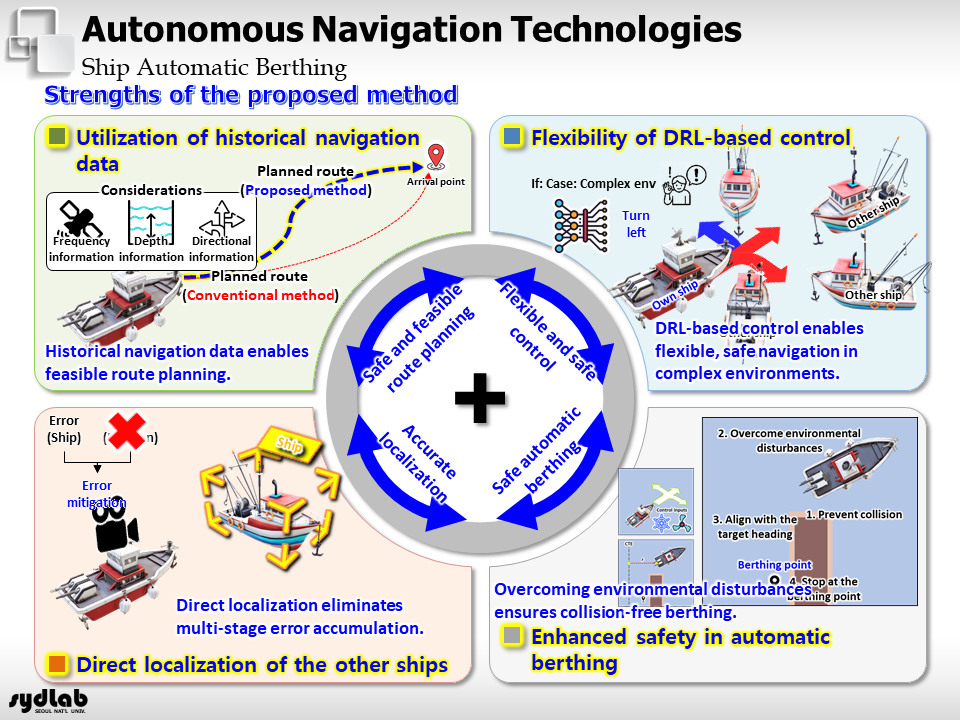
We are studying methods for automatically berthing ships at complex quays. Specifically, we are studying methods that account for the propulsion systems of both small and large ships and enable them to berth accurately at their target locations while avoiding collisions with maritime obstacles and the quay.
– Path planning for automatic berthing – Collision avoidance with maritime obstacles and the quay – Reinforcement learning-based automatic berthing that accounts for berthing orientation
Autonomous Navigation Program
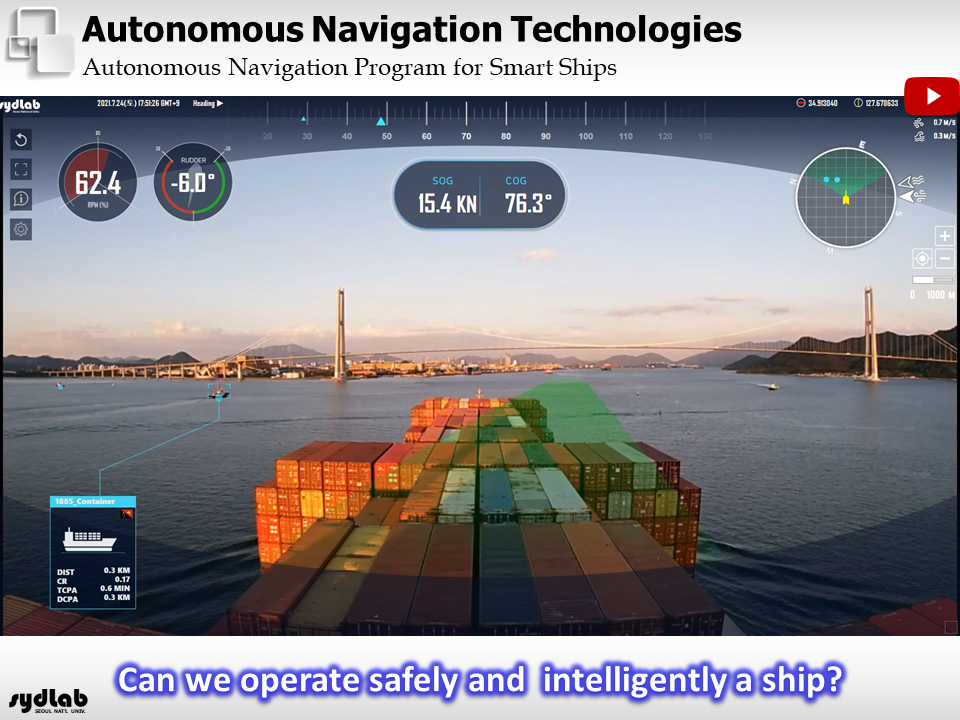
We are developing an autonomous navigation program for smart ships. This program integrates all the technologies currently under development in our lab, including maritime obstacle detection, localization, and tracking; multi-sensor fusion; and ship collision avoidance. The program can also be linked to ocean simulation facility for execution.
– Detection, position prediction, and tracking of maritime obstacles – Multi-sensor fusion – Collision risk assessment and collision-avoidance path generation – Integration with ocean simulation facility