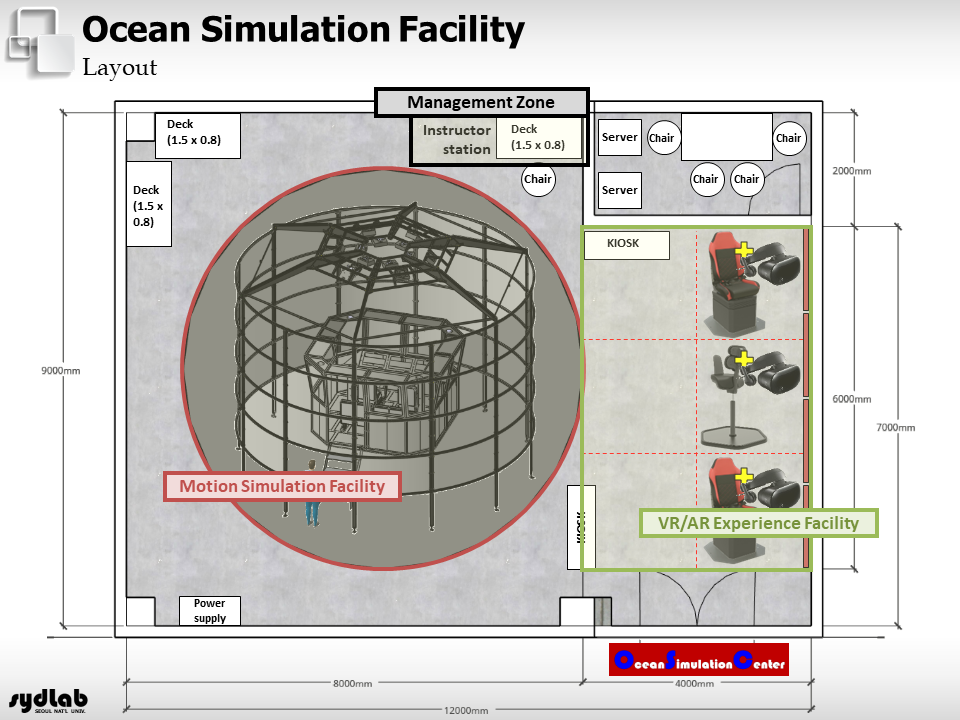
This facility is a simulation platform that integrates analysis, visualization, and hardware, and was developed to perform various simulations of ships and offshore structures. This facility is broadly divided into motion simulation facility and VR/AR experience facility. It was first installed in 2018 and has been undergoing regular maintenance ever since. The facility is installed on the first basement level of Building 34 in the Department of Naval Architecture and Ocean Engineering at Seoul National University. It is currently being actively utilized for educational and research purposes.
Motion Simulation Facility
The motion simulation facility consists of a VR platform, a Work Simulation Platform, and a 6-DOF Motion Platform. The VR Platform, comprising 12 LED beam projectors and a 360-degree surrounding screen, provides a realistic visualization of ships and offshore structures. The Work Simulation Platform is a simplified replica of the control room of ships and offshore structures, serving as the space where operators are seated. The 6-DOF Motion Platform is a multi-jointed device consisting of six pistons that reproduces the 6 DOF motion of ships and offshore structures. These three platforms are interconnected, enabling a wide range of simulations that integrate analysis, visualization, and hardware.
VR/AR Experience Facility
The VR/AR experience facility consists of a multi-vision system, motion chairs, a VR treadmill, and HMDs (Head-Mounted Displays). The multi-vision system comprises eight 65-inch LED TVs that realistically visualize ships and offshore structures. The motion chairs reproduce the 3-DOF motion of ships and offshore structures. The VR treadmill translates the operator’s movements at a fixed location into actual motion. When worn by the operators, the HMDs provide a highly immersive VR/AR experience. They are interconnected, enabling a wide range of simulations that integrate analysis, visualization, and hardware.
Integrated Simulation
By integrating analysis, visualization, and hardware, simulations can proactively identify and address potential issues that may arise during the design, production, and operation of ships and offshore structures. We are using this facility to apply integrated simulations to various challenges in naval architecture and ocean engineering, including block turnover operations involving multiple cranes.