
Introduction
시스템 설계 연구실은 세계 최고의 선박 및 해양 구조물의 설계 기술을 연구하고 있습니다.
At the System Design Laboratory, we are conducting research on the world’s leading design technologies for ships and offshore structures.
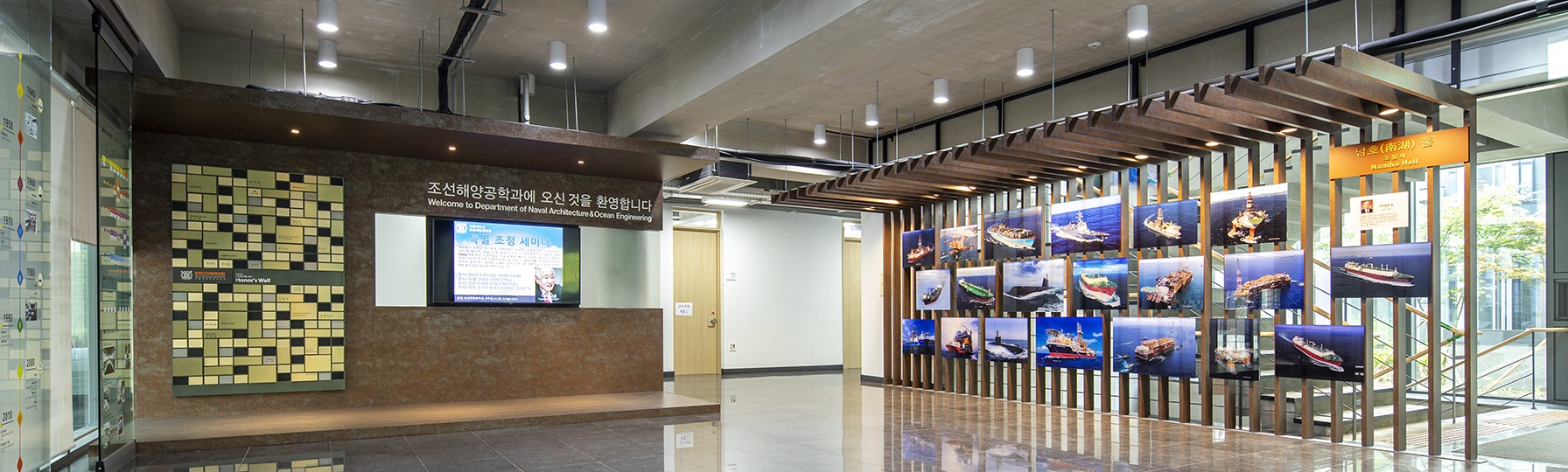
시스템 설계 연구실의 홈페이지에 오신 것을 환영합니다
Welcome to the System Design Laboratory website
2013년 설립된 서울대학교 조선해양공학과 시스템 설계 연구실은 노명일 교수의 지도 아래 여러 연구원이 선박 및 해양 구조물의 설계를 위한 세계 최고의 기술을 연구하고 있습니다. 본 연구실의 연구 분야는 4가지로 요약될 수 있습니다.
첫 번째 분야는 최적 설계 (Optimum Design)입니다. 우리는 선박 및 해양 구조물의 성능 최대화, 비용 최소화, 위험 최소화 등을 목표로 주어진 문제를 최적화 문제로 정식화한 뒤 최적화 알고리즘으로 해결하는 다양한 연구를 수행하고 있습니다.
두 번째 분야는 시뮬레이션 기반 설계 (Simulation-Based Design)입니다. 우리는 기존에 없던 설계 방법을 고안하거나 기존 설계 방법을 개선하는 등 전산 역학 및 시뮬레이션을 활용해 설계 방법을 고도화하는 다양한 연구를 수행하고 있습니다. 또한, 최적화, 시뮬레이션 및 전산화 기술을 복합적으로 활용하여 보다 강건하고 통합적인 설계 결과를 도출하는 다양한 연구를 수행하고 있습니다. 즉, 해석, 가시화 및 하드웨어가 통합된 시뮬레이션 방법론도 연구하고 있습니다.
세 번째 분야는 전산 설계 (Computational Design)입니다. 우리는 최신 인공 지능 기술을 활용하여 사람에 의해 수작업 또는 반자동으로 수행되어 온 설계 작업을 전산화를 통해 자동화하는 다양한 연구를 수행하고 있습니다.
마지막 분야는 자율 운항 기술 (Autonomous Navigation Technologies)입니다. 우리는 스마트 선박을 위한 자율 운항 기술을 연구하고 있습니다. 즉, 해상 장애물 탐지/위치 예측/추적, 다중 센서 융합, 충돌 위험도 평가 및 충돌 회피 경로 생성, 자동 접안 등 최신 기술을 연구하고 있습니다.
끝으로 본 연구실은 해양 시뮬레이션 장비 (Ocean Simulation Facility)를 운영하고 있습니다. 우리는 설계 결과를 실제와 유사한 환경에서 검증하기 위해 VR/AR 기술을 연구하고 있고 시뮬레이터를 자체적으로 구축해 운용하고 있습니다. VR/AR 기술은 현실 세계를 컴퓨터에 실감나게 그려 놓은 느낌을 주고, 시뮬레이터는 현장의 움직임을 사람에게 그대로 전달합니다. 이 시뮬레이터는 다양한 문제에 적용할 수 있도록 범용적으로 만들어져 활용도가 매우 높습니다.
본 연구실에 대한 상세한 내용은 홈페이지에서 확인하실 수 있으며, 궁금한 점은 언제든지 연락 주십시오. 세계 최고의 선박 및 해양 구조물의 설계 기술을 개발하기 위해 열심히 노력하겠습니다. 감사합니다.
Established in 2013, the System Design Laboratory in the Department of Naval Architecture and Ocean Engineering at Seoul National University in the Republic of Korea is led by Professor Myung-Il Roh, where researchers are studying the world’s leading design technologies for the design of ships and offshore structures. The laboratory’s research areas can be summarized into four categories.
The first area is Optimum Design. We are studying various research projects aimed at maximizing the performance of ships and offshore structures, minimizing costs, and reducing risks by formulating given problems as optimization problems and solving them using optimization algorithms.
The second area is Simulation-Based Design. We are studying a variety of research projects aimed at advancing design methods through computational mechanics and simulation, including the development of novel methods and the improvement of existing ones. In addition, we are studying a variety of research projects that combine optimization, simulation, and computational techniques to produce more robust and integrated design results. In other words, we are also studying simulation methods that combine analysis, visualization, and hardware.
The third area is Computational Design. We are studying various research projects that use the latest artificial intelligence technologies to automate design tasks—traditionally performed manually or semi-automatically by humans—through computerization.
The final area is Autonomous Navigation Technologies. We are studying autonomous navigation technologies for smart ships. Specifically, we are studying cutting-edge technologies such as the detection, localization, and tracking of maritime obstacles; multi-sensor fusion; collision risk assessment and collision-avoidance path generation; and automatic berthing.
Finally, our laboratory operates an Ocean Simulation Facility. We are conducting research on VR/AR technologies to validate our design results in a realistic environment, and we have built our own simulator. VR/AR technology creates a realistic representation of the real world on a computer, while simulators faithfully replicate on-site movements for users. This simulator is designed to be versatile, making it extremely useful for a wide range of problems.
You can find detailed information about our laboratory on our website. Please feel free to contact us at any time if you have any questions. We are committed to developing world-class design technologies for ships and offshore structures. Thank you.