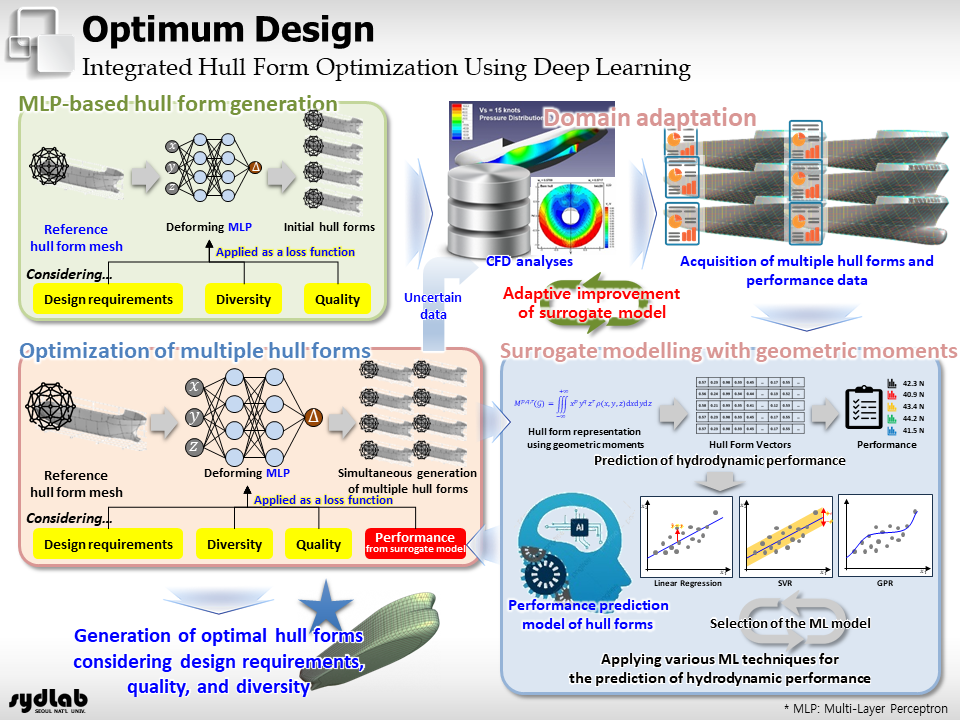
우리는 제한적인 최적화로 인해 상당한 시간이 소요되던 전통적인 선형 최적화 과정을 개선하기 위해 통합 선형 최적화 방법을 연구하고 있습니다.
– MLP (Multi-Layer Perceptron) 구조를 이용한 선형 표현 – 자동 갱신형 근사 모델 (surrogate model) – MLP 구조와 자동 갱신형 근사 모델 기반의 선형 최적화
We are studying an integrated method for hull form optimization to improve upon the existing method, which was time-consuming and underperformed.
– Representation of hull forms using an MLP (multilayer perceptron) architecture – Self-updating surrogate model – Hull form optimization based on the MLP architecture and the self-updating surrogate model
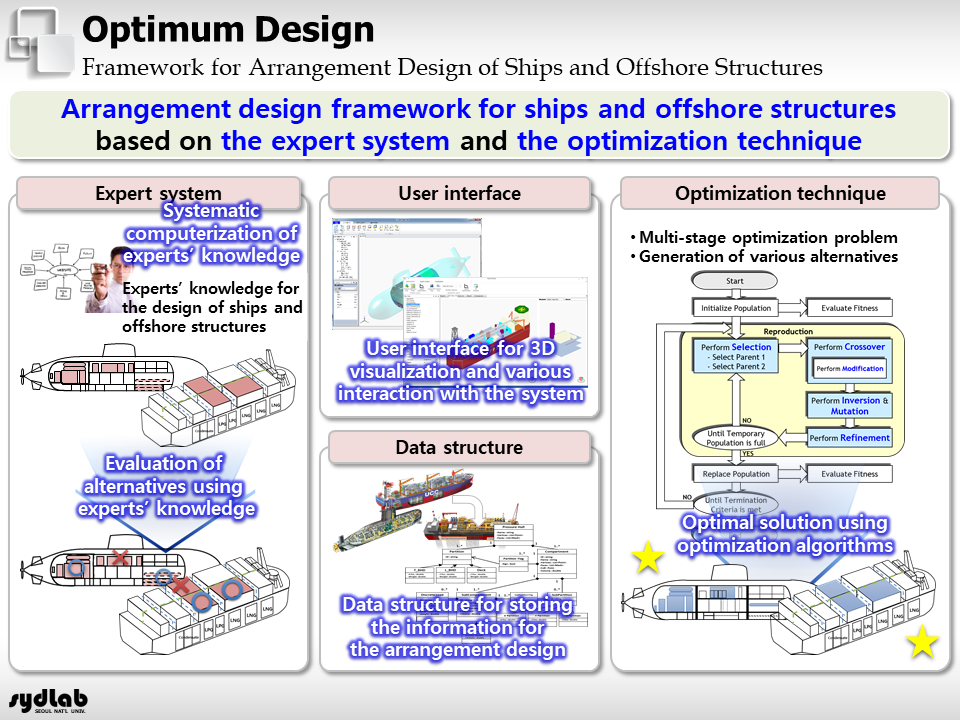
배치 설계 프레임워크 (Arrangement Design Framework)
우리는 선박 및 해양 구조물의 배치 설계를 위한 표준화된 프레임워크를 연구하고 있습니다. 제안된 프레임워크는 함정의 구획 및 장비 배치, 선박 기관실 내 장비 배치, 해양 구조물 상부 (FPSO Topside)의 모듈 및 장비 배치 등 다양한 예제에 적용되었습니다.
– 배치 설계 정보를 저장하기 위한 자료 구조 – 배치 설계를 위한 전문가 시스템 – 배치 최적화 문제의 정식화와 최적화 알고리즘 – 사용자 인터페이스
We are studying a standardized framework for the arrangement design of ships and offshore structures. The proposed framework has been applied to various examples, including the compartment and equipment arrangement of naval ships, the equipment arrangement in ship engine rooms, and the arrangement of modules and equipment on the topside of offshore structures (FPSO).
– Data structures for storing arrangement design information – Expert system for arrangement design – Formulation of the arrangement optimization problem and optimization algorithms – User interface
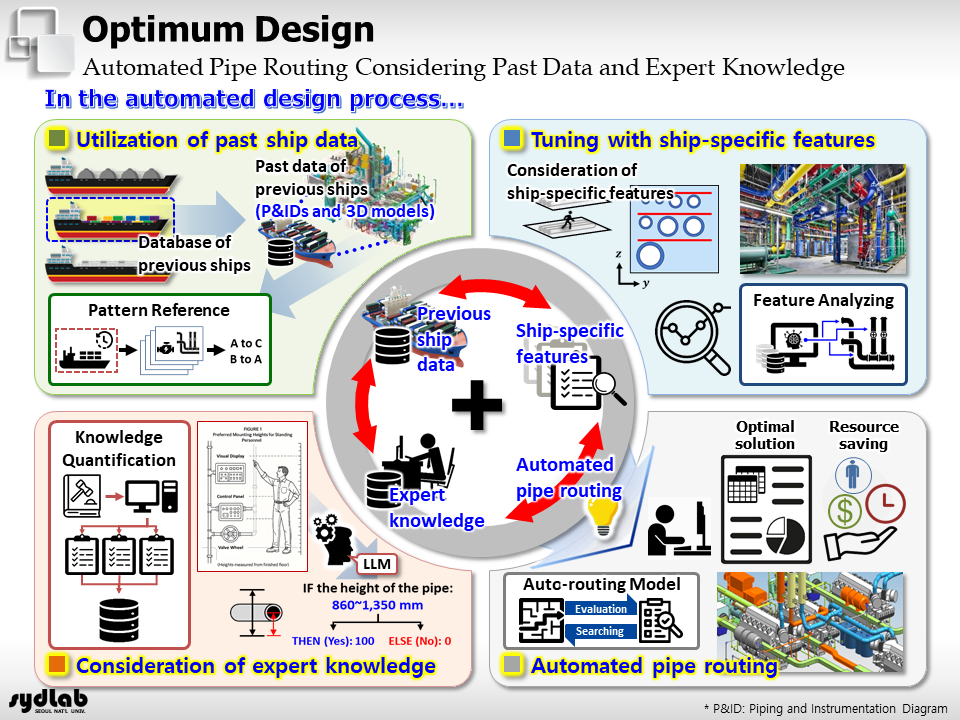
자동 배관 라우팅 (Automated Pipe Routing)
우리는 배관 라우팅에 대한 과거 실적 데이터, 전문가 지식, 선박 배관 라우팅 특성을 고려한 자동 배관 라우팅 방법을 연구하고 있습니다. 특히, 실제 조선소 업무에 활용 가능한 실용적인 방법을 연구하고 있습니다.
– 딥 러닝을 활용한 과거 실적 데이터와 DB화 – 전문가 지식 및 경험을 전산화한 전문가 시스템 개발 – 선박 배관 라우팅 특성을 고려한 알고리즘 적용 – 편집 설계 등 효율적인 배관 라우팅 알고리즘 탑재
We are studying an automated pipe routing method that accounts for past data of previous ships, expert knowledge, and ship-specific features. In particular, we are focusing on developing a practical method for use in actual shipyard operations.
– Utilizing deep learning to analyze past data of previous ships and create a database – Developing an expert system that digitizes expert knowledge and experience – Applying algorithms that account for ship-specific features for pipe routing – Incorporating efficient pipe routing algorithms, such as an editing design function
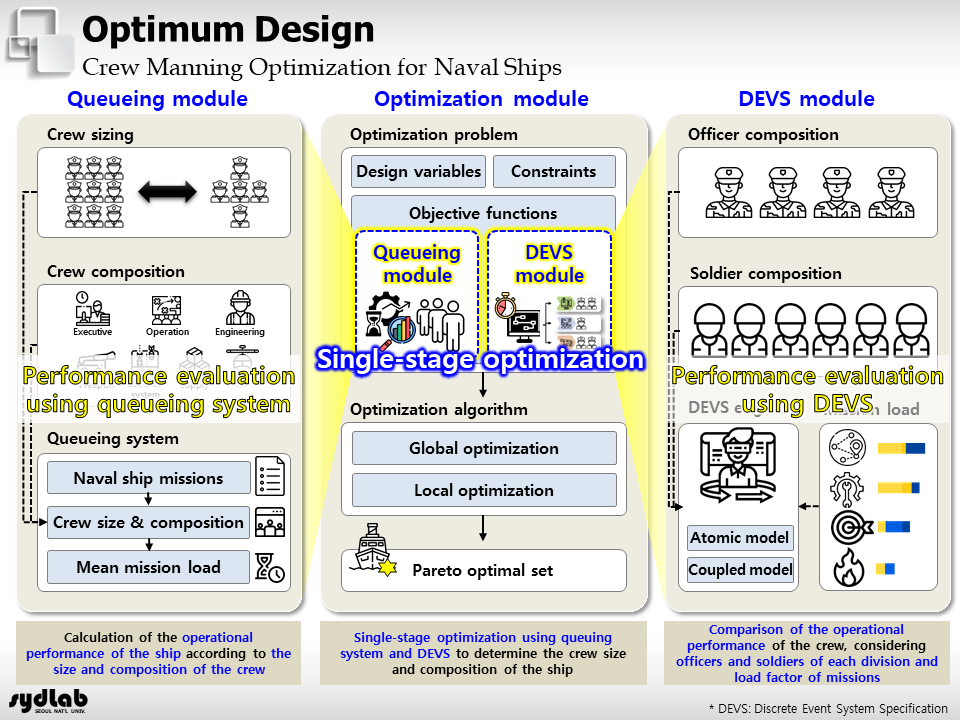
함정 승조원 운영 최적화 (Crew Manning Optimization)
우리는 스마트 함정을 위한 승조원의 운영 최적화 방법을 연구하고 있습니다. 즉, 함정의 운용 특성을 고려하여 다양한 시나리오에 따른 승조원 배치, 즉 부서별·직무별·계급별 승조원 수를 최적화하는 방법을 연구하고 있습니다.
– 과거 실적 데이터를 활용한 초기 승조원 배치 결정 – 전문가 시스템을 활용한 승조원 배치 조정 – 이산 사건 시뮬레이션 (DEVS)을 활용한 시나리오별 승조원 배치 안의 성능 평가 – 전역 최적화 알고리즘을 활용한 승조원 배치 최적화
We are studying an optimization method for crew manning of smart naval ships. Specifically, we are studying how to optimize crew composition—that is, the number of crew members by department, job function, and rank—across various scenarios, while accounting for the operational characteristics of the naval ship.
– Determining initial crew composition using past data of previous ships – Adjusting crew composition using an expert system – Evaluating the performance of scenario-specific crew composition using Discrete Event Simulation (DEVS) – Optimizing crew composition using global optimization algorithms
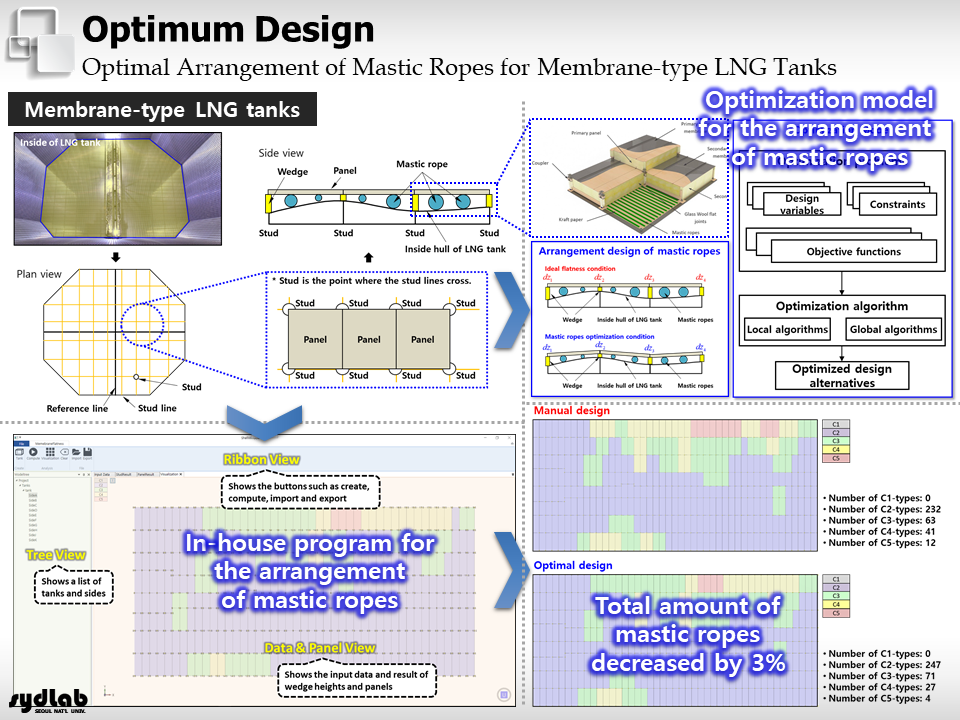
LNG 화물창 매스틱 로프 최적화 (Mastic Rope Optimization)
우리는 LNG 화물창 내에서 선체와 단열재 패널 사이에 설치되는 매스틱 로프의 사용량을 줄이기 위한 최적화 방법을 연구하고 있습니다.
– 매스틱 로프의 배치를 위한 in-house 프로그램 – 매스틱 로프의 사용량 최소화를 위한 최적화 문제 정식화와 최적화 알고리즘 – 매스틱 로프의 패턴 최적화 방법
We are studying an optimization method to reduce the amount of mastic ropes used between the hull structure and the insulation panels inside LNG cargo tanks.
– In-house program for mastic rope arrangement – Formulation of the optimization problem and optimization algorithms to minimize mastic rope usage – Method for optimizing mastic rope patterns
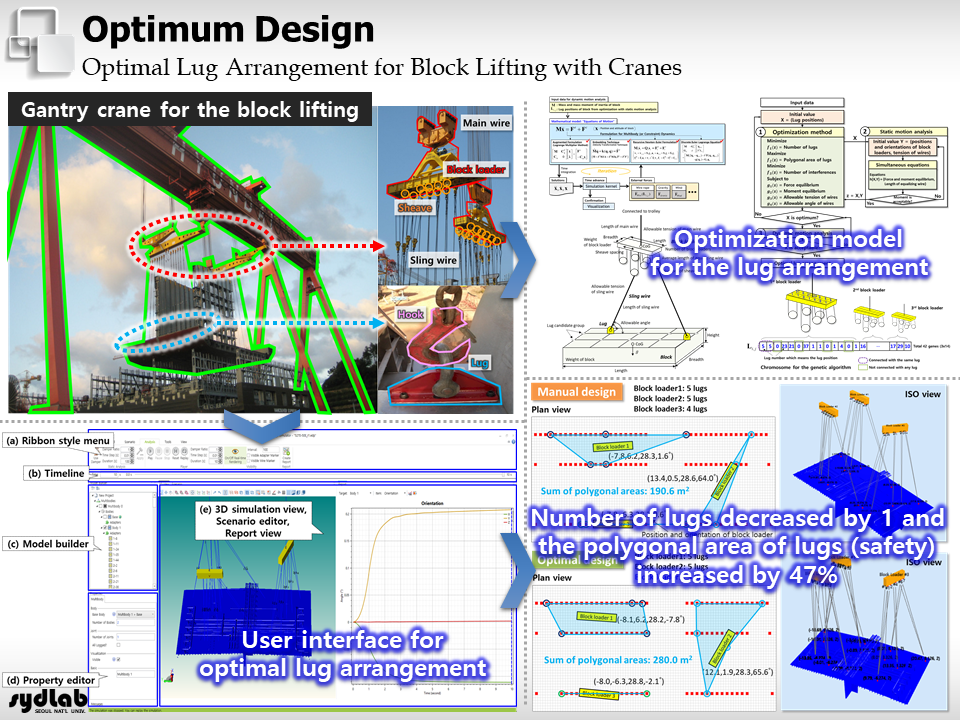
블록 러그 배치 최적화 (Optimal Lug Arrangement)
우리는 크레인을 이용한 블록 탑재에 필요한 각종 러그의 최적 배치 방법을 연구하고 있습니다. 제안된 방법은 블록의 형상과 무게 중심을 고려해 블록의 안전한 탑재 (탑재 중 블록 낙하 및 움직임 방지)를 위한 러그의 최소 개수와 최적 위치를 결정합니다.
– 러그 배치에 따른 블록 초기 위치 계산 – 다물체 동역학 기반 블록의 자세와 장력 계산 – 러그 배치 최적화 문제의 정식화와 최적화 알고리즘
We are studying the optimal arrangement of the various lugs required to lift blocks using a crane in shipyards. The proposed method determines the minimum number and optimal positions of lugs to ensure safe lifting of blocks (preventing blocks from falling or shifting during lifting) by considering the block’s shape and center of gravity.
– Calculation of the block’s initial position based on lug arrangement – Calculation of the block’s orientation and tension using multibody system dynamics – Formulation of the optimization problem for lug arrangement and optimization algorithms